If you want to get people to buy your stuff, you need to understand how consumers make purchasing decisions.
Buyers rarely make decisions from one source of information. They compare alternatives, read reviews, search for evidence, ask other people, and increasingly use social platforms and AI tools to narrow their options.
That is particularly visible in B2B. G2’s 2025 Buyer Behavior Report, based on more than 1,100 B2B decision-makers, found that GenAI chatbots and software review sites had become the two biggest influences on vendor shortlists, ahead of vendor websites, market research firms, peers, and salespeople.
Product quality, price, reputation, and fit still matter. But once those fundamentals are in place, psychology influences how buyers interpret the information in front of them, reduce uncertainty, and decide which option feels right.
TL;DR
- Reviews still influence purchasing decisions. BrightLocal research found that 85% of consumers were more likely to use a business after positive reviews, while 77% were deterred by negative reviews.
- Buyers combine multiple sources rather than relying on one channel. G2’s B2B research shows AI, review sites, vendor content, independent research, peers, and salespeople all influence shortlists.
- What buyers say influenced them does not always explain what actually drove the choice. Self-reported research works best alongside observed behavior.
- Ease, familiarity, social norms, context, emotion, and framing can all affect how a choice is evaluated.
- There is no credible universal rule that 70% of decisions are emotional or 95% of purchases are subconscious. Those numbers oversimplify much more complex decision processes.
Table of contents
- What is a purchase decision?
- How can you influence purchase decisions?
- 1. Use reviews to help decide on products and companies
- 2. Consider that people gather buying recommendations from mixed sources
- 3. Understand that people don’t often know why they like something
- 4. Analyze the crowd to understand buyer preferences
- 5. Use simplicity for decision-making
- 6. For retail stores, even flooring influences purchasing decisions
- 7. Social media doesn’t only influence buying decisions, it fills the cart.
- 8. When it comes to buying, we make emotional decisions and rational justifications
- 9. Unconscious processes influence purchase decisions
- Key takeaways on purchase decisions
- Improve how you understand buyer behavior
What is a purchase decision?
A purchase decision is the stage in the consumer decision-making process where a buyer chooses whether or not to purchase a product or service. It follows key steps, including:
- recognizing a need;
- searching for information;
- evaluating alternatives;
- choosing whether to purchase.
Once the purchase is made, the process often concludes with post-purchase evaluation, where the buyer assesses their satisfaction with the product or service.
Factors such as product quality, price, reviews, brand reputation, and emotional influences all play a vital role in shaping this decision.
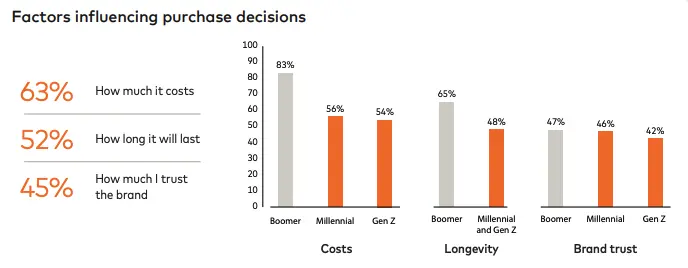
Mastercard’s 2026 global research shows “Factors influencing purchase decisions”, which includes cost, longevity, and brand trust by generation.
How can you influence purchase decisions?
Understanding your customers’ behavior or why they make purchase decisions is more than just about driving sales, increasing conversion rates, and gaining a competitive edge. It’s about creating long-term relationships built on trust and loyalty and, ultimately, enhancing customer satisfaction.
Here are nine ways you can win over customers as they make a decision to buy:
1. Use reviews to help decide on products and companies
Reviews remain an important part of purchase research, but how consumers use and trust them has changed.
In BrightLocal’s 2026 Local Consumer Review Survey, 97% of respondents said they read online reviews when researching businesses. Positive reviews made 85% more likely to use a business, while negative reviews deterred 77%.
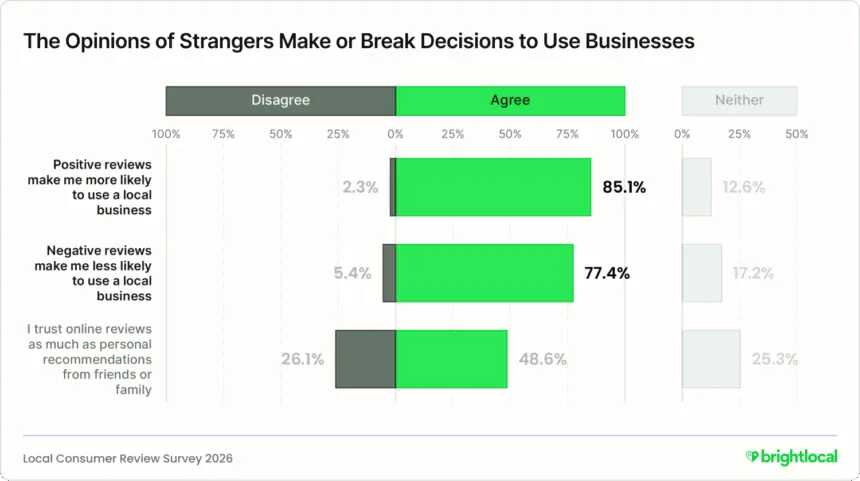
But reviews rarely finish the decision by themselves. After reading a positive review, 66% continued researching while 34% were ready to purchase or book. And only 49% said they trust online reviews as much as recommendations from friends and family.
The lesson isn’t simply “get five stars.” Buyers use review sentiment, volume, recency, detail, and other sources to judge whether the evidence is credible.
So start gathering reviews on your site. If you sell commodity products, you might want to pull reviews from an external site so that you can display more of them. Use structured data to get review stars from highly reviewed products into search results. Our internal study on the impact review stars showed that they can increase click-through-rates by as much as 35%.
More reviews can help insulate your reputation from the inevitable impossible-to-please customer. That said, don’t delete negative reviews. They actually help sales if there are only a few of them and they’re politely worded.
If there are tons of negative reviews, most people are naturally turned off and look elsewhere.
2. Consider that people gather buying recommendations from mixed sources
Buyers rarely rely on a single source when evaluating a purchase. They discover options in one place, validate them somewhere else, compare the remaining choices, and then look for enough evidence to justify the decision.
That process is increasingly obvious in B2B software buying.
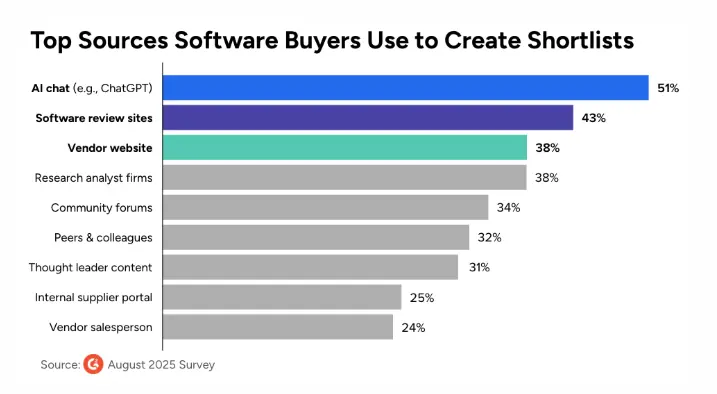
G2’s research with more than 1,000 B2B software buyers found that the sources used to create vendor shortlists are spread between AI, third-party validation, vendor-controlled information, and human recommendations.
In its 2025 research, 51% used AI chatbots to help create software shortlists, followed by software review sites at 43%. Vendor websites and research analyst firms were both used by 38%, community forums by 34%, peers and colleagues by 32%, thought leadership by 31%, internal supplier portals by 25%, and vendor salespeople by 24%.
More recent G2 research shows that the mix continues deeper into the decision. Its 2026 Buyer Behavior Report found that review sites were the top source influencing B2B software shortlists at 38%, closely followed by AI chatbots at 37%. More than 80% of buyers had also used an AI chatbot to source software recommendations during the previous two years.
But discovery and shortlisting are only part of the decision. In the same 2026 study, 40% of buyers said evaluation was now the longest stage of the buying journey. Once a vendor was selected, security review was the biggest source of delay at 39%, followed by budget approval at 32% and implementation planning at 25%.
For marketers, that means the buying decision is distributed between different sources and different stakeholders. A buyer might discover you through AI, validate the product through reviews and peer discussion, use your website to understand pricing and integrations, and then need evidence that survives security and finance review.
The practical implication isn’t to identify one “best” channel. It’s to make sure the claims buyers encounter remain credible when they move between channels. Product information, customer proof, comparisons, pricing context, implementation details, and third-party validation all contribute to the same decision.
3. Understand that people don’t often know why they like something
A classic 1991 study by Timothy Wilson and Jonathan Schooler demonstrates why explanations of preference need to be interpreted carefully.
Participants evaluated different brands of strawberry jam. Some simply rated the jams, while others were first asked to analyze the reasons behind their preferences.
The participants who analyzed their reasons produced ratings that corresponded less closely with expert ratings than those who evaluated the jams without explaining why. The researchers argued that asking people to explain a preference can make easily verbalized attributes more prominent, even when those attributes were not the main drivers of the original judgment.
This doesn’t mean customer interviews or surveys are unreliable. They can reveal language, objections, needs, expectations, and how customers interpret an experience.
What they cannot always establish is causality. A customer can accurately report what they noticed or felt without necessarily being able to reconstruct every process that caused the preference.
For marketers, that means combining stated preferences with observed behavior. Listen to what customers say, then compare it with what they click, buy, abandon, renew, or choose when alternatives are presented.
Takeaway: Treat customers’ explanations as evidence, not a perfect record of what caused the decision.
4. Analyze the crowd to understand buyer preferences
Many preferences are shaped by familiarity, previous experience, category conventions, and social expectations. Over time, these can influence what customers consider “normal” or desirable within a product category.
An old Washington Post column uses the example of clam chowder. Decades ago, it was thin. But now, it’s almost uniformly thick. What happened? At some point, restaurateurs got in the habit of adding flour to make chowder thicker and thicker. Now, this is what consumers have come to consider a bowl of “authentic” clam chowder.
These learned preferences can just as easily involve characteristics that, from an objective standpoint, don’t make a product any better—and might even make them worse, especially when it comes to texture.
Ravi Dhar, a marketing professor at the Yale School of Management, notes that although Heinz ketchup does not reliably win in blind taste tests, it has established itself as the gold standard in its category because it’s thicker. In the marketing world, Dhar says, “meaningless attributes often lead to meaningful differentiation.”
Ever wondered why so many products on store shelves are so similar? Wouldn’t it be better to make them different? Not necessarily.
“There are huge incentives in consumer markets, even for competing companies, to make everything the same, ” says Dan McGinn, president of a research and strategy consultancy in Arlington, Virginia.
Yes, our preferences evolve as society evolves. That impacts our purchasing decisions. A “family car” used to mean a station wagon. Then it was a minivan. Now, it’s an SUV.
If you’re interested in this concept, we’ve written an article on the idea of familiarity as a marketing tactic. Essentially, the more we’re exposed to something, the more likely it is that we’ll develop a preference for it and decide to buy it.
Takeaway: Understand the conventions customers already associate with your category before deciding which ones to follow and which ones to deliberately challenge. Differentiation is useful when customers understand why the difference matters, not simply because the product looks or behaves unlike everything else.
5. Use simplicity for decision-making
Cognitive fluency describes how easily information can be processed or understood. Familiar language, readable design, recognizable patterns, and offers that are easy to compare generally require less mental effort.
That ease can influence judgments. Research on processing fluency has shown that even factors such as how easily a company name can be pronounced can affect evaluations under some conditions.
For marketers, the useful principle isn’t that everything should be stripped down. Buyers still need enough information to judge the product properly. The objective is to remove unnecessary cognitive effort from understanding the offer.
Older mobile-phone pricing provides a useful example of this principle
Consumers once had to compare combinations of call minutes, text allowances, data limits, overage fees, and contract terms. An unlimited option reduced much of that calculation to a more understandable proposition: one allowance without continually calculating usage.
That did not necessarily make the unlimited option cheaper or objectively better for every customer. It made the decision easier to evaluate.
The same principle applies to pricing and packaging today. If buyers have to decode overlapping feature lists, usage thresholds, add-ons, credits, and exceptions before they can understand which option fits them, complexity itself becomes part of the purchase decision.
Previous positive experiences matter
Cognitive fluency also explains
- Why you continue to buy from brands and service providers you’ve used before;
- Why you often order the same thing from the menu.
It’s just easy. You’ve tried it, it worked, and you don’t want to spend a bunch of time researching alternatives. You don’t want to risk a bad purchase.
As a marketer, this means it’s super important to get a customer to decide on that first purchase. Pack your first offer with value and make it as easy as possible to buy. Once consumers have their first positive buying experience, it’s much easier to get repeat purchases.
Hard to read, hard to buy
Make your website easy to read. When people read something in a difficult-to-read font, they transfer that sense of difficulty onto the topic they’re reading about.
The same goes for products and purchases. We’ve conducted a number of original studies on e-commerce product pages. In one of those studies, we found that the way products are described matters. The format of text descriptions influences how people perceive the products themselves.
Takeaway: Remove unnecessary effort from the purchase decision, but don’t remove information buyers genuinely need to compare options and judge whether the product is right for them.
6. For retail stores, even flooring influences purchasing decisions
Research by Joan Meyers-Levy suggests that the way people judge products may be influenced by the ground beneath them.
“When a person stands on carpeted flooring, it feels comforting,” says Meyers-Levy. “But the irony is that when people stand on carpet, they will judge products that are close to them as less comforting.”
When people were standing on soft carpet and viewed a product that was moderately far away, they judged that item’s appearance to be comforting. However, people who examined products while standing on the same plush carpet judged items that were close by as less comforting.
This experiment was conducted in a physical retail environment, so it does not establish that the same flooring effect has a direct digital equivalent.
What it does demonstrate is that context can affect product evaluation even when the contextual cue seems unrelated to the product itself.
That is relevant to marketers because products and offers are never evaluated in isolation. The surrounding comparison set, imagery, copy, pricing presentation, page hierarchy, default selections, and other contextual cues can change how the same offer is interpreted.
But those digital effects need to be tested independently rather than inferred from the flooring experiment.
Takeaway: Treat context as part of the buying experience. Seemingly peripheral details can affect judgment, but test the effect in the environment where the purchase actually happens.
7. Social media doesn’t only influence buying decisions, it fills the cart.
Social media now plays a role in discovery, product research, recommendation, and purchase rather than acting only as an awareness channel.
Sprout Social’s Q2 2025 Pulse Survey of more than 2,200 social users in the US, UK, and Australia found that 76% said social content had influenced a purchase during the previous six months. That increased to 84% among Millennials and 90% among Gen Z.
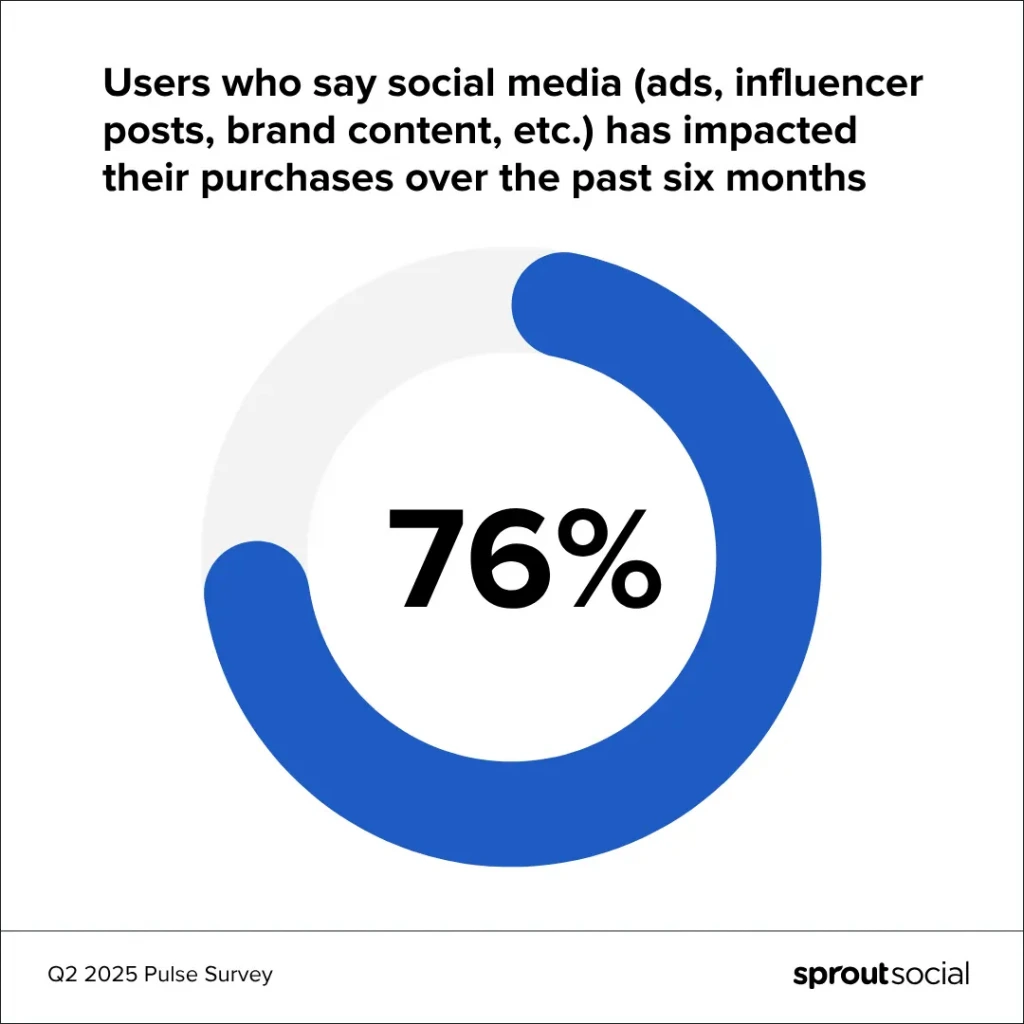
Social is also becoming part of the research process itself. In the same study, 37% of consumers said they preferred to start on social platforms when searching for product reviews and recommendations. Among Gen Z, 41% said social was their first destination when searching for information generally, ahead of traditional search engines.
That influence can happen without the final transaction taking place inside the platform. A customer might discover a product through a creator, look for comments and reviews, visit the brand site, compare alternatives elsewhere, and purchase later.
For B2B marketers, the equivalent may be less about an in-app checkout and more about peer recommendations, employee posts, expert commentary, communities, and thought leadership influencing which companies buyers investigate next.
But social media is shifting from being a passive marketing tool to an active, immersive shopping destination.
Nike’s earlier use of augmented-reality try-ons is one example of social and mobile experiences reducing the distance between product discovery and product evaluation. Instead of seeing only a static product image, shoppers could interact with the product in a more personalized context before making the decision.

Platforms like Flipkart and Brightcove are paving the way for fully immersive “window shopping” experiences with video e-commerce or live shopping. Between January and June 2024, over 75 million users engaged with video content while shopping on Flipkart, collectively spending more than 2 million hours on its video commerce offerings, including Vibes and Liveshop+.
Social media engagement has an influence, too
Research suggests that Facebook “Likes” alone do not have a strong direct impact on consumer purchase decisions.
Studies revealed that while liking a brand on Facebook allows users to follow updates, it does not necessarily indicate a positive attitude toward the brand or influence purchasing behavior, nor does it significantly change consumer attitudes or behaviors. Participants’ attitudes toward brands remained unchanged regardless of whether they liked the brand on Facebook, indicating that pre-existing positive attitudes toward a brand were more influential than the act of liking it.
However, Facebook “Likes” can have a more meaningful effect when combined with paid advertising. Other studies showed that boosted reach through paid ads led to a notable increase in program participation. Additionally, although social media fandom, including likes and followers, could increase brand awareness and purchase intent, it had a lesser impact on actual financial outcomes.
These findings suggest that while Facebook likes can help spread awareness, they are not a direct driver of sales or purchase behavior without additional strategies like paid advertising or meaningful consumer engagement.
8. When it comes to buying, we make emotional decisions and rational justifications
Purchase decisions are not cleanly divided into a fixed percentage of “emotion” and “logic.” Emotion, automatic processing, deliberate evaluation, previous experience, and context interact throughout the decision.
More useful research looks at whether emotional experience is associated with actual customer outcomes.
Qualtrics XM Institute analyzed 354 brands in 22 industries and compared customer ratings for success, effort, and emotion with trust, forgiveness, purchase intent, and recommendation. Emotion showed the strongest relationship with all four outcomes.
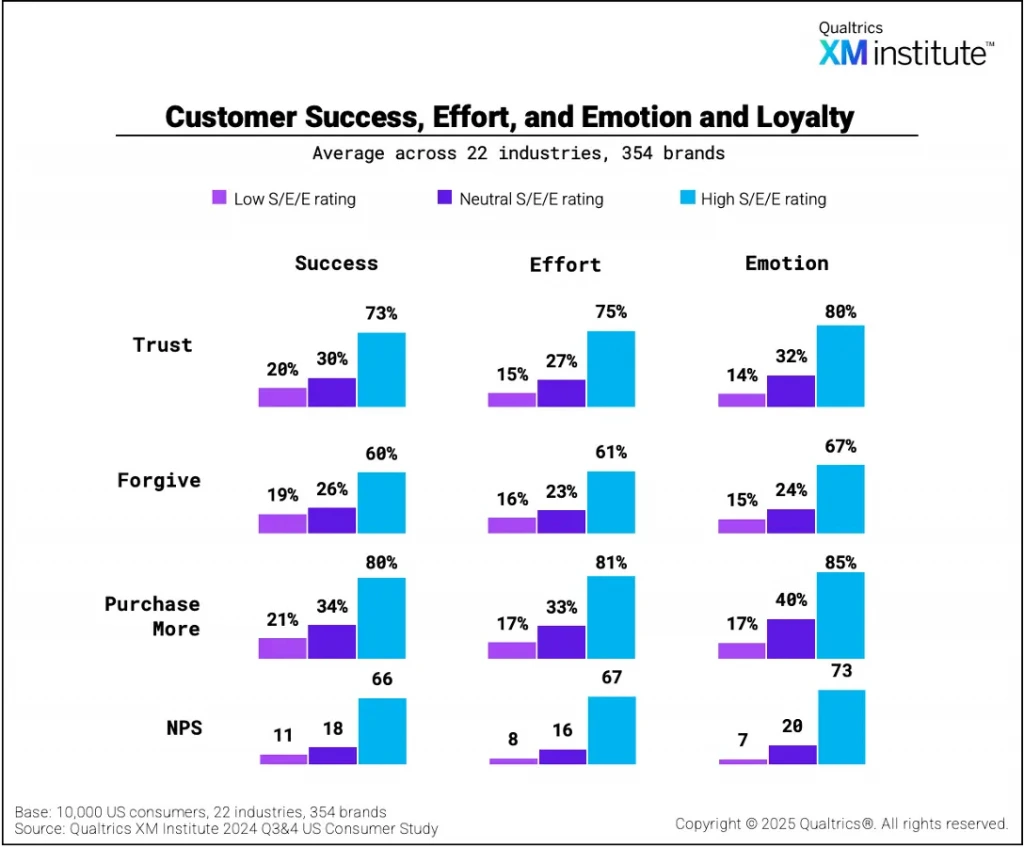
Among customers giving brands high emotion ratings, 85% said they intended to purchase more, compared with 17% among customers giving low emotion ratings. High emotion ratings were also associated with substantially higher trust, forgiveness, and NPS.
This does not mean product performance or rational evidence stops mattering. In the same research, customer success and effort were also strongly related to purchase intent. The useful finding is that functional delivery and emotional experience are not competing explanations for buying behavior.
Antonio Damasio’s research helped establish a similar broader principle: emotion is involved in decision-making rather than operating as something entirely separate from rational thought.
It is also worth being precise about dual-process theory. System 1 is fast and automatic, while System 2 is slower and more deliberative. They should not simply be translated into “System 1 = emotional” and “System 2 = rational.” Automatic judgments can involve learned knowledge, and deliberate reasoning can still be affected by emotion.
What does this mean for marketers?
Emotional relevance can come from far more than sentimental advertising. Buyers can feel confidence, anxiety, trust, uncertainty, excitement, relief, or fear of making the wrong choice.
This is particularly important in B2B, where a purchase may affect budgets, careers, security, implementation effort, and other stakeholders. A buyer can be evaluating ROI rationally while simultaneously asking whether the vendor feels credible and whether choosing it creates personal or organizational risk.
Strong marketing therefore needs both sides. Give buyers reasons to care, then give them the evidence needed to defend the decision: customer results, product capabilities, price, implementation detail, risk reduction, and proof of value.
9. Unconscious processes influence purchase decisions
Not every process involved in a purchase decision is conscious or deliberate. Habits, learned associations, previous experiences, attention, memory, and automatic judgments can all affect how an option is evaluated before someone deliberately reasons through the choice.
Gerald Zaltman’s work is frequently cited here, particularly the claim that 95% of purchasing decisions occur subconsciously.
The source needs some context. Harvard Business School’s own introduction to Zaltman’s work describes 95% of purchase decision-making as taking place in the subconscious, but the question put directly to Zaltman refers to his broader claim that 95% of cognition occurs outside conscious awareness.
In other words, marketers should not treat “95% of purchase decisions are subconscious” as though researchers directly measured every buying decision and established a universal 95/5 split.
The more defensible point is that consumers do not have conscious access to every process influencing what they notice, remember, prefer, or choose.
That matters when interpreting customer research. Buyers can give useful and sincere explanations of their choices while still being influenced by processes they cannot fully articulate.
Although we may focus on facts and numbers, in many cases, it’s the subliminal that makes people decide one way or another, which is often driven by emotion.Additionally, cognitive biases such as the framing effect demonstrate how the presentation of information can shape decision-making. The framing effect occurs when people react differently to information depending on how it’s presented, such as emphasizing potential gains or losses.
“People make most choices… by identifying options as good or bad and then ranking them. This process of editing and evaluating choices means that our perception is biased by the way information is presented. Presenting the same information positively…or negatively…can influence people’s perceptions of those facts and their choices.”
—Dr. Regina Lazarovich, PhD, clinical psychologist and founder of Compass CBT
Framing matters because equivalent information can be interpreted differently depending on how the choice is presented. A gain, loss, percentage, price difference, guarantee, or risk can draw attention to different aspects of the same underlying decision.
For marketers, that means presentation is part of the offer. A message emphasizing time saved may be evaluated differently from one emphasizing money saved, even when both describe the same product outcome.
The objective should not be to hide information or manipulate customers into decisions they would otherwise reject. Use framing to make the value, cost, risk, and consequences of a choice easier to understand, then test which presentation helps customers evaluate the offer most effectively.
Takeaway: Buyers do not consciously reconstruct every influence on a purchase. Use behavioral evidence alongside self-reported research, and treat framing as something to test rather than a guaranteed psychological trick.
Key takeaways on purchase decisions
Purchase decisions are shaped by more than product features and price.
Buyers gather evidence from different sources, compare alternatives, rely on previous experience, respond to social proof and category conventions, and interpret information through both deliberate and automatic processes.
Reviews can reduce uncertainty. Familiarity can make an option easier to choose. Context can change how the same product is evaluated. Emotional responses can affect trust and purchase intent. And the way information is framed can change how buyers interpret the decision in front of them.
None of these principles should be treated as universal persuasion tricks.
A finding from a retail experiment, social-media study, or consumer-psychology paper does not automatically transfer to every B2B buying journey. The audience, product, stakes, buying group, and environment all matter.
Use these findings to identify better questions:
- Where are buyers looking for evidence before they choose?
- Which parts of the decision create unnecessary effort or uncertainty?
- What information helps them justify the purchase?
- Which assumptions come from what customers say, and which are supported by observed behavior?
- Which changes are worth testing with your own audience?
The goal is not to manipulate buyers. It is to understand how decisions are made well enough to remove unnecessary friction, communicate value clearly, and give customers the evidence they need to make a confident choice.
Frequently asked questions about purchase decisions
What influences a purchase decision?
Price, product fit, quality, trust, reviews, previous experience, social proof, perceived risk, ease of evaluation, emotion, and context can all influence a purchase decision.
Do online reviews influence purchasing decisions?
Yes. Reviews can materially affect trust and consideration, although buyers often continue researching after reading them.
How do B2B buyers research purchase decisions?
B2B buyers typically combine several sources, including AI tools, review sites, vendor websites, independent research, peers, communities, and sales conversations.
Does social media influence purchase decisions?
Yes. Social content can influence discovery, product research, recommendations, and purchases, although the effect varies by audience and platform.
Are purchase decisions emotional or rational?
Both. Emotional responses and deliberate reasoning interact throughout the decision process; there is no universal percentage split between the two.
Are 95% of purchase decisions subconscious?
No reliable study establishes that exact percentage for purchasing decisions. The figure comes from a broader claim about unconscious cognition.
Improve how you understand buyer behavior
Understanding purchase decisions becomes more useful when you connect psychology with customer research, experimentation, and real behavioral evidence.
Understand how psychology shapes marketing decisions: CXL’s Digital Psychology & Behavioral Design course covers cognitive biases, motivation, trust, decision-making, and behavioral design.
Go deeper into persuasion and consumer behavior: The Digital Psychology & Persuasion Minidegree covers behavioral psychology, persuasion models, neuromarketing, and how customers evaluate choices.
Turn buyer insight into better conversion decisions: The Conversion Optimization Minidegree covers customer research, experimentation, analytics, and optimization.
Related Posts
-

As optimizers, so much of our focus is spent on the pre-conversion phase. How do…
-

What is the most common problem with websites? What should you change? Make better decisions…
-
Most of the personal development advice there assumes you have no kids. I don't want…
-
Hiring is tough. Interviews and not even their history are not perfect to assess somebody's…





Good staff.
Very interesting article. The cognitive fluency point really rang true with both what I do and with what I see from my customers.
Any insight on how consumers perceive comparing their product to a competitor at shelf VS being a favorable choice on social sites?
Cognitive fluency. Brilliant way to rationalize the critical need for simplicity in sales. Fantastic data!
great